History,
underfoot.
Discover the visual language of Turkish rugs—and learn how centuries-old craft can shape a room today.
Not decoration.
A living archive.
A Turkish rug carries place, memory and the hand of its maker. Motifs once moved from village to village; colors came from roots, leaves and minerals; each weave balanced utility with expression.
Carpet Mahal brings that world into focus—without turning it into a museum piece. We connect origin and technique to the practical questions of scale, material, care and contemporary styling.
Read the Anatolian field guide →Four traditions.
Four distinct voices.
“Turkish rug” is not one look. Region, community, technique and purpose create a remarkable range of visual identities.
Bold geometry
Strong medallions, saturated reds and village-scale confidence.
UŞAKSoft grandeur
Large-scale florals and luminous palettes made for generous rooms.
KONYAAncient rhythm
Grounded color, memorable forms and deep Central Anatolian roots.
KİLİMWoven language
Flatwoven geometry: light, graphic and full of symbolic resonance.
 THE HUMAN HAND
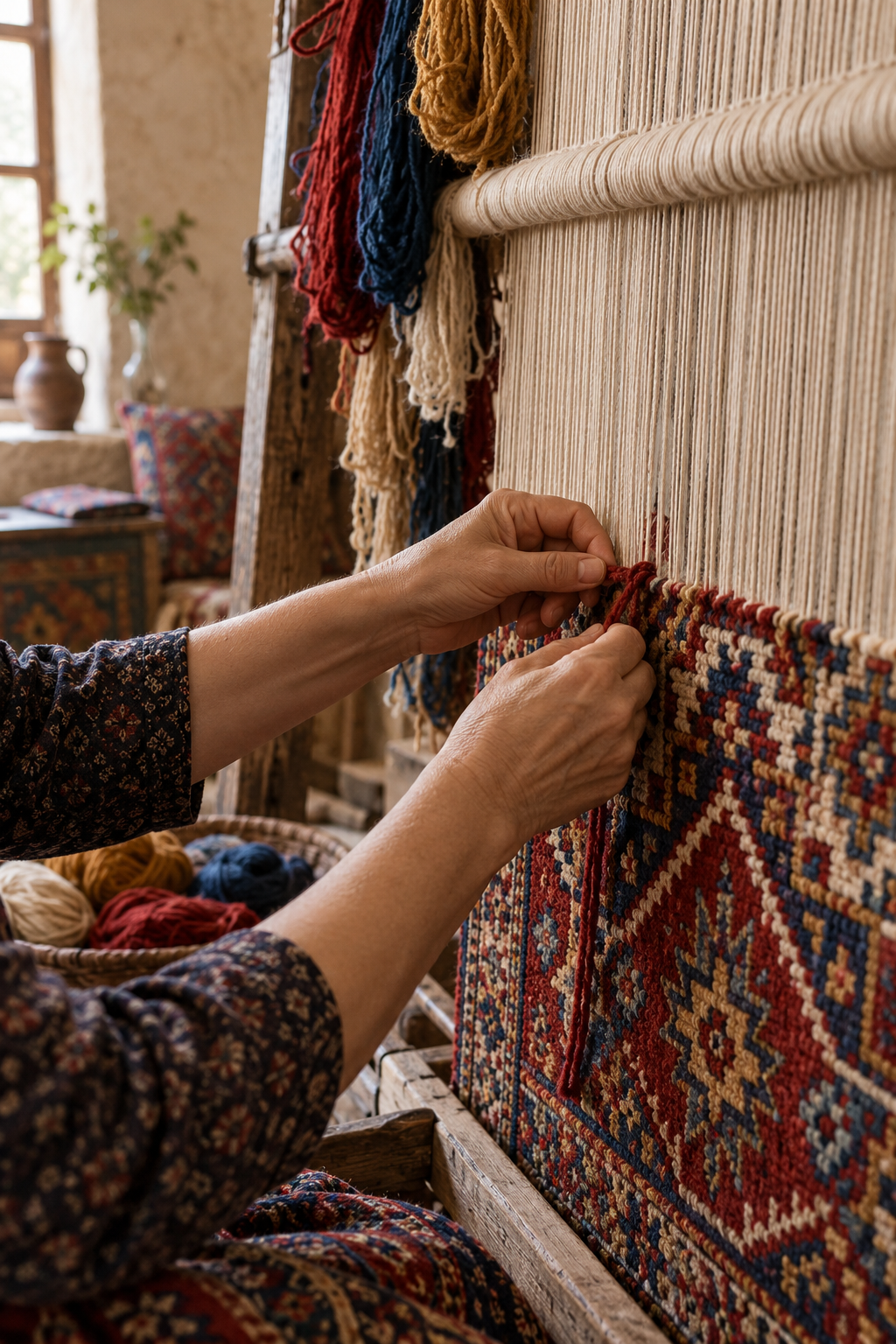
Knot by knot,
time becomes texture.
In a hand-knotted rug, every knot is tied around the warp before the weft locks the row into place. The process is slow by nature. That pace creates the dense surface, subtle irregularity and tactile depth that machines imitate but never quite repeat.
The rug should lead the room.
Begin with proportion, then fiber, then feeling. A rug that connects the furniture will always look more considered than one chosen by color alone.
Open the room-by-room guide