The Turkish knot
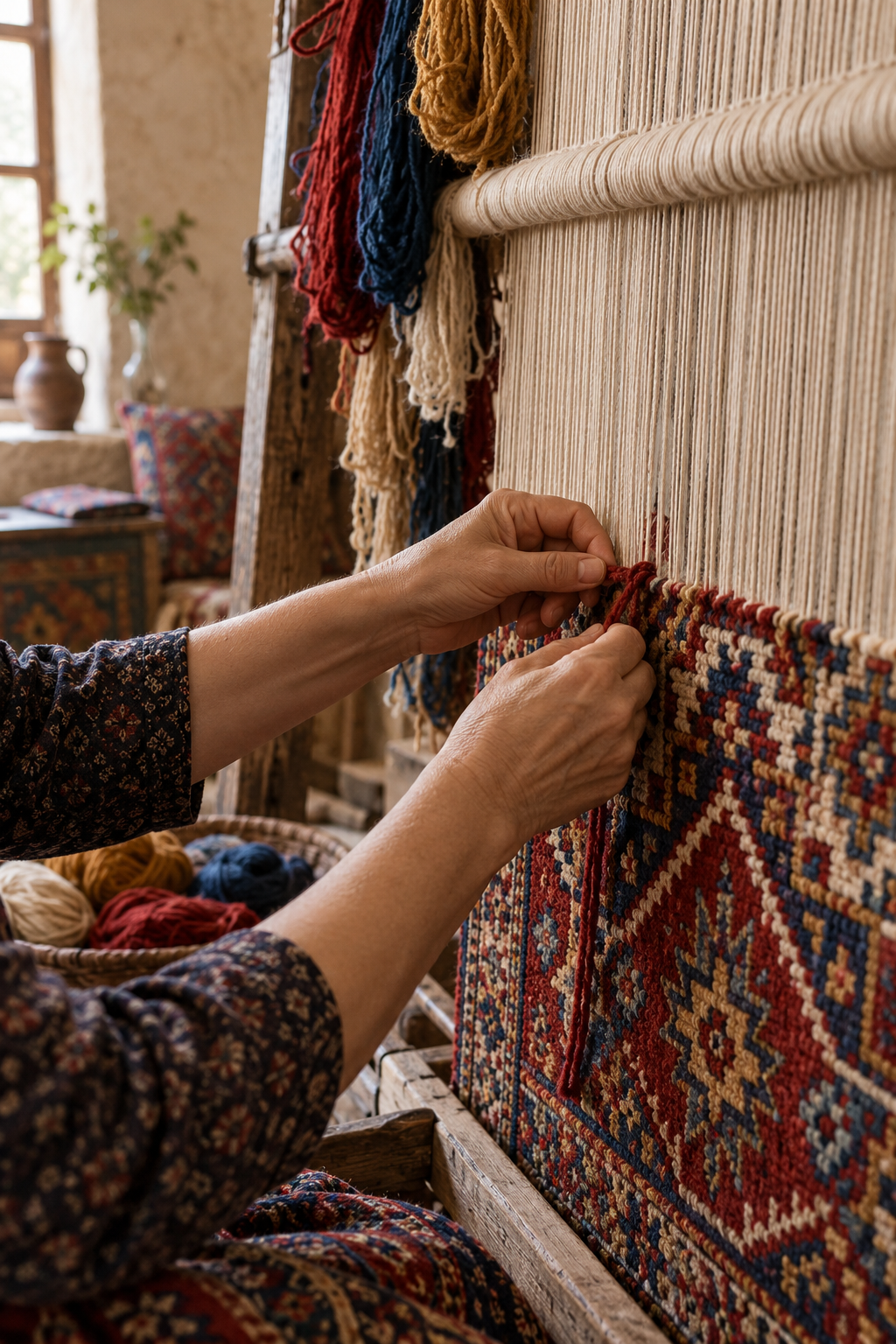
Many Turkish pile rugs use the symmetrical Gördes knot, wrapped around two adjacent warp threads. It creates a firm structure suited to geometric drawing. Construction alone does not identify origin, however: palette, motif, material, age and provenance all matter.
Uşak: generous scale
Historic Uşak carpets are celebrated for large medallions, sweeping arabesques and palettes that can feel surprisingly modern. Their open compositions work especially well in rooms that need warmth without visual congestion.
Bergama: graphic confidence
Bergama traditions often favor strong geometry, saturated reds and emphatic central forms. The visual energy is direct, making these rugs natural anchors for restrained interiors.
Konya: grounded rhythm
Konya rugs encompass varied workshop and village expressions. Collectors recognize powerful geometry, rich reds and yellows, and compositions with a steady architectural quality.
Kilim: pattern without pile
Kilims are flatwoven rather than knotted. Their light structure and crisp, stepped geometry make them versatile in contemporary rooms, whether used on the floor, layered over a larger rug or displayed as textile art.
Reading motifs carefully
Popular names are often assigned to recurring forms, but meanings can shift by region, era and interpreter. It is better to treat motifs as part of a visual vocabulary than as a fixed code.
Geometric medallions
Forms that organize the field and create a strong center of gravity.
Hooked contours
Stepped and hooked outlines that animate borders and repeating units.
Tree-like forms
Vertical, branching compositions associated with growth in many traditions.
Regional descriptions are broad orientation, not authentication advice. Age, origin and value should be assessed by a qualified specialist who can examine the rug in person.